The actual distinction: what gets measured
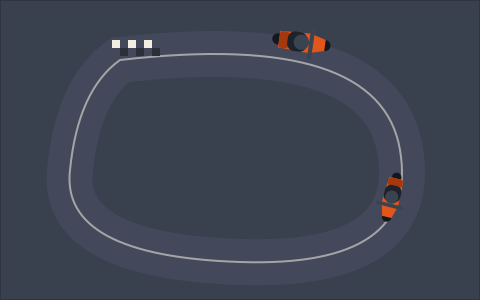
A racing game measures you against a track or an opponent. Lap times, finishing positions, sector splits. There is a defined route and a defined end, and your performance is comparable to somebody else's on the same route.
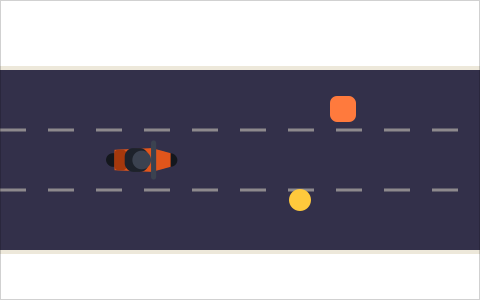
An arcade game measures you against a score. There is often no route, no finish line and no opponent — just a number that goes up until you make a mistake.
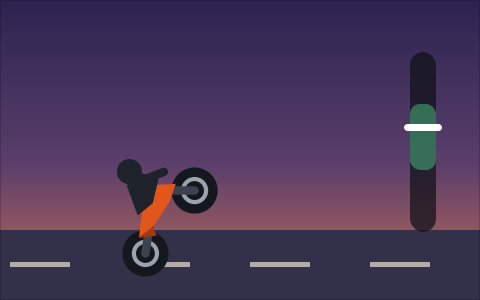
That is the whole distinction. It is not about speed, artwork or realism, and it is why City Bike Racer is both an arcade game and a racing game, while Motorcycle Wheelie is only the former.
What follows: physics
Racing games tend toward more detailed physics, because comparing lap times only means something if the vehicle behaves consistently and predictably. Simulation is the far end of that spectrum: tyre temperature, suspension geometry, weight transfer modelled in detail.
Arcade games tend toward legible physics, because a score chase depends on quick understanding of what went wrong. Our games use a simplified rigid-body model precisely so that failures are attributable within a second — see how arcade physics work for what that means in practice.
Neither is better. They serve different measurement schemes.
What follows: session length
Racing games have a natural session length — the length of a race. Even a short race is usually a minute or two, and you cannot meaningfully leave halfway through.
Arcade games end when you make a mistake, which makes sessions self-selecting: thirty seconds when you are learning, three minutes when you are good. That is why the arcade format dominates browser games and phones. A game you can abandon after twenty seconds without losing anything fits the way people actually use those devices.
What follows: what improvement feels like
In a racing game, improvement is measurable in a way that feels rigorous: your lap time drops by a specific amount and you know which corner it came from.
In an arcade game, improvement is lumpier. Scores are noisy — a single early mistake ends a run — so you improve in plateaus and jumps rather than smoothly. That is worth knowing because it stops you reading a bad run as a loss of skill.
Where simulation fits
“Simulation” is a third category and it is not on the same axis. A simulator tries to model a real vehicle accurately; whether it measures you against a lap time or a score is a separate question.
Nothing on this site is a simulator, and we say so on our disclaimer page. The bikes here lean further, land more forgivingly and recover faster than real motorcycles, and the games are not riding instruction.
Which you probably prefer
If you enjoy learning a fixed thing deeply — a circuit, a course, a sequence — you probably prefer racing games and fixed-course arcade games. Try City Bike Racer and Impossible Bike Track.
If you prefer a fresh situation every time and a number to push, you probably prefer score-chase arcade games. Try Motorcycle Rush and Highway Bike Racer.
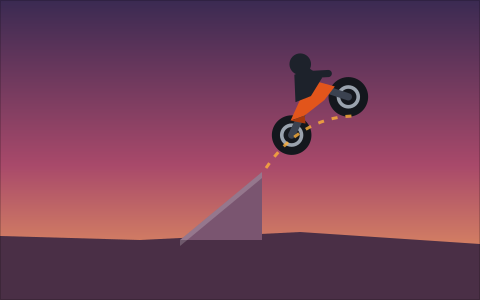
If you like mastering a single difficult skill, the balance and stunt games are the answer: Motorcycle Wheelie and Moto Stunt Challenge.