The bike is a body with two springy wheels
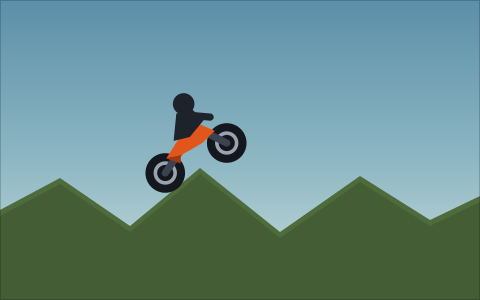
In every side-view game here, the bike is a rigid body with a position, a velocity and a rotation. Two wheels sit at either end of it. When a wheel overlaps the ground, the game applies an upward force proportional to how far it has sunk in, minus a damping term based on how fast it is moving.
That is it — and it produces surprisingly rich behaviour for free. Because the force is applied at the wheel rather than at the centre, it also creates a twist. Land on the rear wheel and the nose gets pushed up. Land on the front and the tail comes over. You never had to be told that; it falls out of the model.
It also explains why the bike settles onto whatever slope it is riding: the downhill wheel sinks in slightly more, twisting the body until both wheels are equally loaded.
Traction: why the throttle sometimes does nothing
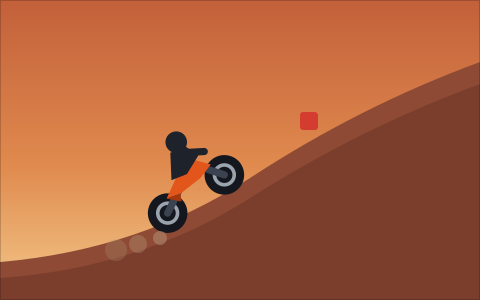
Drive is applied at the rear wheel, along the direction of the ground. But it is capped by how hard that wheel is being pressed into the surface. Ask for more force than the contact can transmit and the surplus is wasted as wheelspin.
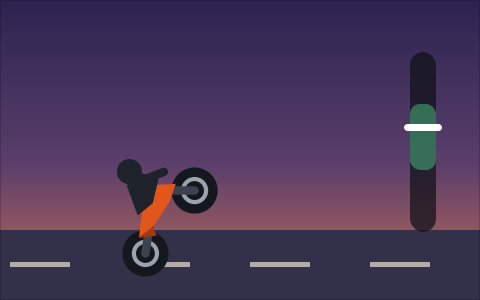
That single rule is the entirety of Hill Climb Motorcycle. On a steep slope, the rear wheel is less loaded and the cap is lower, so the same throttle input that worked on the flat now mostly spins. The traction bar shows you exactly how much you are wasting, and easing off genuinely climbs faster.
It also explains why leaning back helps on a climb: it shifts load onto the driven wheel, raising the cap. And why leaning too far back stops helping — once the front wheel unloads entirely, you loop.
Rotation momentum, and why stunts are hard
Lean inputs apply a twist to the body. In the air there is almost nothing to damp it, so releasing the input stops adding rotation but leaves whatever you have already built.
This is the single most important thing to understand about stunt games. The bike does not stop when you let go; it coasts. So the correct release point is roughly a quarter turn before where you want to end up.
On the ground, the same twist has a competing force pulling the bike back onto the slope, which is why lean on the ground gives you a controllable wheelie rather than a flip.
Why landings are judged against slope
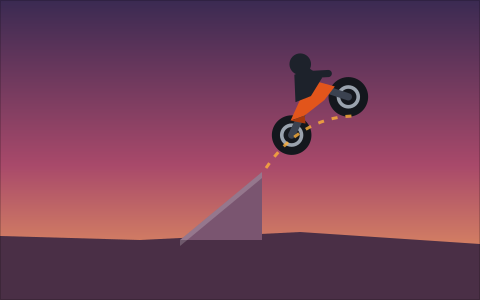
At the moment your wheels touch, the game compares the bike's rotation to the slope of the ground beneath it. If the difference exceeds a tolerance, the bike cannot get both wheels down and it goes over.
Measuring against the slope rather than against level is physically sensible and it is the detail that catches people. Landing perfectly level on a steep downhill is a large angle error; landing nose-down there is correct. The landing markers in our games show the angle relative to the ground you are about to hit, which is why watching the marker beats watching the bike.
Balance: the inverted pendulum
Motorcycle Wheelie and Motorcycle Balance both use the same idea. The further you are from centre, the harder something pulls you further from centre. That is what makes balancing hard, and it is exactly how a real bike balanced on a beam behaves.
The practical consequence: correction has to be proportional and early. A large correction applied late overshoots, and because the system is unstable, the overshoot then accelerates away from you in the other direction. Small taps, applied before the error is large, is not a stylistic preference — it is the only strategy that works on an unstable system.
If the bike starts oscillating left and right, stop inputting entirely for a moment. The oscillation is your own corrections fighting each other.
What we deliberately do not model
No tyre temperature, no suspension geometry, no engine braking curves, no aerodynamics beyond a simple drag term, no gyroscopic effects, no rider weight shift separate from the bike. A real motorcycle's stability comes largely from gyroscopic and trail effects that we do not simulate at all.
The reason is legibility. The point of an arcade game is that you understand what went wrong within a second of it happening. Every additional system makes failures harder to attribute, and a failure you cannot attribute feels unfair even when it is not.
What this means for you as a player
- Lean back for grip on climbs, forward to stop a loop.
- Ease the throttle when the wheel spins — you are not slower, you are faster.
- Release rotation early; the bike coasts.
- Match the slope you are landing on, not level ground.
- Correct balance in small, early taps.