How landing angle is actually judged
When your wheels touch down, the game compares the bike's rotation to the slope of the ground beneath it at that moment. Inside a tolerance you land and keep your points; outside it you crash.
Two details matter. First, it is measured against the slope, not against level — so landing nose-down on a downhill is correct, and landing level on a downhill is not. Second, it is measured at the moment of contact, so being level a fraction of a second later is worth nothing.
Moto Stunt Challenge draws a landing marker under the bike that turns green when your angle is safe for the ground you are about to hit. Watch that marker rather than the bike.
Rotation has momentum — this is the whole problem
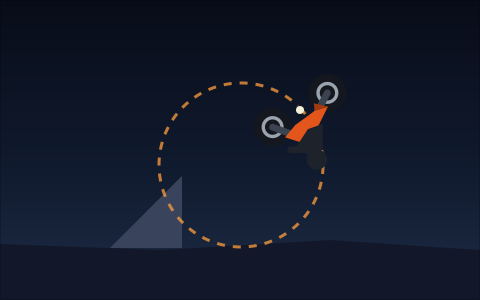
Releasing the rotation input stops adding spin. It does not cancel the spin you already have. The bike keeps turning for a noticeable moment afterwards, and that overshoot is what breaks most landings.
The fix is to release at the top of the arc rather than on the way down. You want the remaining momentum to carry you to level, not past it. Practically, that means releasing roughly a quarter of a rotation before you want to stop.
This is also why mixing directions in one jump is a trap: a frontflip input applied to cancel a backflip does not neatly stop you, it swings you the other way.
Speed buys rotation, not points
Entering a ramp faster gives you more air time, which gives you time for more rotation. It does not directly give you points in any game here.
This has a practical consequence people miss: too much speed on a short ramp is actively bad. You get air time you cannot fill with useful rotation, and you land further down the terrain where the slope may be against you. Braking before a small ramp is often correct.
In Bike Flip Master this becomes explicit — if you are consistently landing at three-quarters of a rotation, you are releasing on time but rotating too slowly, so the fix is entering the ramp faster rather than holding the flip key longer.
Combos: what breaks them and what does not
Combo systems reward you for chaining ramps, and they break in two ways: a crash, or letting the window expire before you reach the next ramp.
In Stunt Ramp Rider the multiplier drains specifically while your wheels are on the ground, which means rolling slowly between ramps is the most common way to lose it. Braking to line up a jump is fine; cruising is not.
The strategic skill is recognising a section that will not chain and letting the combo go deliberately rather than throwing it into a crash. Chasing a dying multiplier costs far more than rebuilding one.
A practice order that works
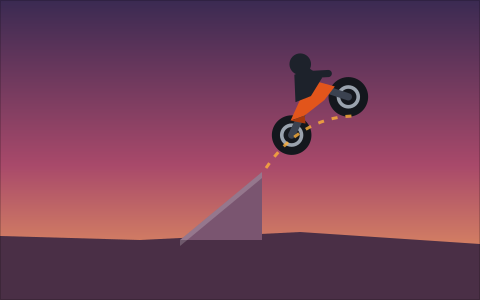
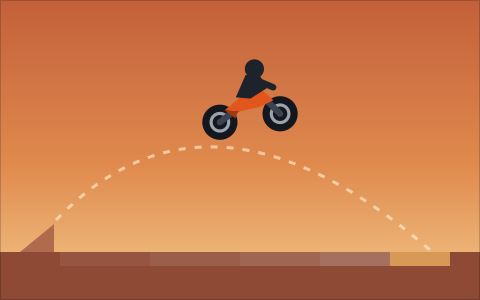
- Extreme Bike Jump — learn how arcade jump arcs behave with no in-flight control to worry about. Around forty-five degrees gives the most distance for a given power.
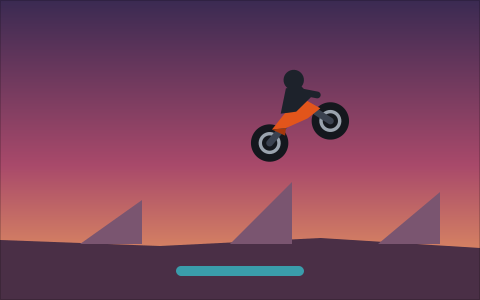
- Stunt Ramp Rider — get comfortable being airborne and chaining ramps, with no landing-angle penalty to punish you.
- Moto Stunt Challenge — add the landing check. Deliberately do half-rotations you can land cleanly before attempting full flips.
- Bike Flip Master — whole flips only, on a fixed course you can memorise.
The mindset that helps most
A three-quarter flip landed clean beats a full flip crashed, every single time. Take the points you can keep.
Players who plateau in stunt games are almost always attempting more rotation than they can stop. Deliberately under-rotating for a full run — taking half flips you land perfectly — builds the release timing far faster than repeatedly crashing full flips does.