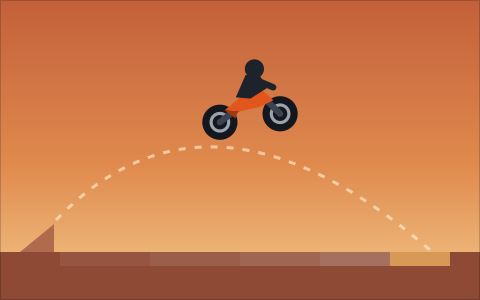
Moto Stunt Challenge — scores rotation, checks your landing
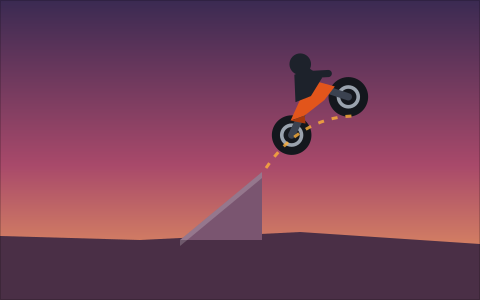
Moto Stunt Challenge pays per degree of rotation, but only if the bike touches down within a safe angle of the ground beneath it. That one rule creates the entire tension: a full backflip landed forty degrees off level is worth nothing but a crash.
Good players spend the last third of every jump correcting rather than spinning. Clean landings also open a combo window, so reaching the next ramp quickly keeps the multiplier alive.
Learn this one first. The landing-angle skill it teaches is assumed by everything else in the category.
Bike Flip Master — scores whole flips only
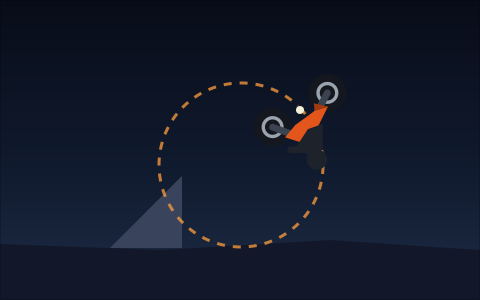
Bike Flip Master takes the same rotation mechanic and discards anything short of a complete turn. Land after one and a half flips and the half pays nothing.
That single change flips the decision-making. Instead of squeezing out every degree you are constantly asking whether there is time for one more full rotation — and the answer usually depends on how much speed you carried out of the previous landing.
The course is fixed rather than generated: eight ramps in the same order every attempt, which makes it learnable in a way generated stunt games are not.
Stunt Ramp Rider — scores air time, ignores angle
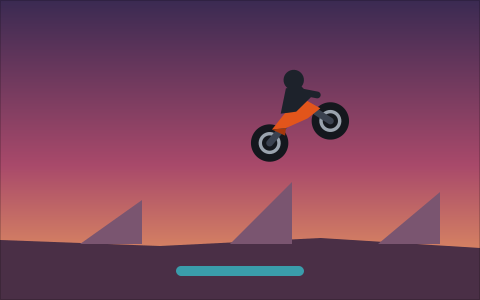
Stunt Ramp Rider pays for being airborne. There is no landing angle to get wrong, which makes it the most approachable stunt game here. What it asks instead is that you keep being airborne: a combo multiplier climbs with each ramp and drains while your wheels are on the ground.
Ramp spacing is generated, so some sections chain beautifully and some do not. Recognising a section you cannot chain — and choosing to reset rather than throwing the combo into a crash — is where the good runs come from.
Motorcycle Wheelie — scores balance, not stunts
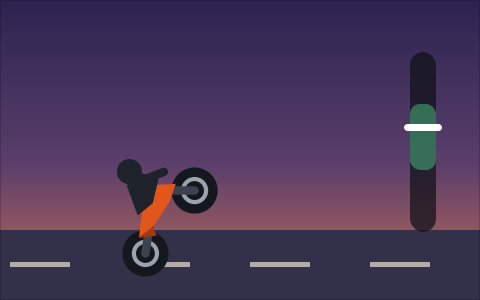
Motorcycle Wheelie is technically a stunt game and practically a control-theory exercise. Hold the throttle to pitch the bike back, release to let it drop, and keep the pitch inside a narrow band where the wheelie is stable. Distance accrues only while you are inside that band.
It has the steepest learning curve on the site, and the band narrows as your speed climbs, so a long run gets harder the longer it goes.
Extreme Bike Jump — scores where you land, nothing else
Extreme Bike Jump removes in-flight control entirely. A meter sweeps an angle gauge, you lock it; a second sweeps a power gauge, you lock that; the bike launches and you watch. Scoring zones get narrower and more valuable further out.
It is the easiest to pick up and a surprisingly good way to internalise how arcade jump arcs behave — around forty-five degrees really does give the most distance for a given power.
The one thing that separates good stunt players
Almost every stunt failure is over-rotation, not under-rotation. Rotation has momentum: releasing the input stops adding spin but does not cancel what you have already built.
So the skill is not starting the rotation, it is stopping it — at the top of the arc, not on the way down. Players who learn that in Moto Stunt Challenge find Bike Flip Master immediately more manageable, because the same instinct tells you whether one more flip will fit.