Hard because the control is unstable
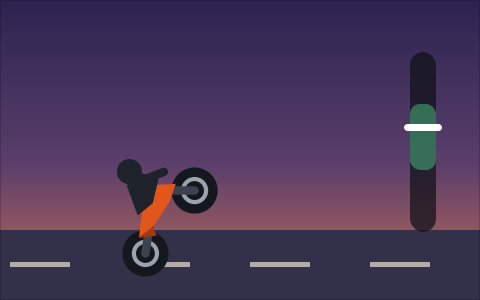
Motorcycle Wheelie has the steepest early curve here. One input, one number, and a balance window that narrows as your speed climbs — so a long run gets harder the longer it goes. Almost every loop-out is a hold that should have been a tap.
Motorcycle Balance tests the same instinct on a different axis, and adds a crosswind. Because forward motion is optional, it is the purest test of whether you can leave a stable system alone.
Both reward the same discipline: correct early, correct small, and stop inputting when the bike starts oscillating.
Hard because information is withheld
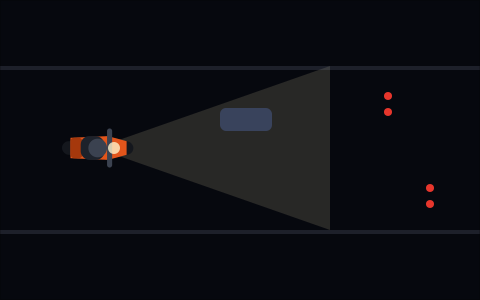
Night Highway Rider gives you a headlight cone and tail lights. Learning to identify a vehicle from the spacing of two red dots is the actual skill, and score scales with speed so playing safe scores badly. That combination — difficulty you choose, information you lack — is what earns the rating.
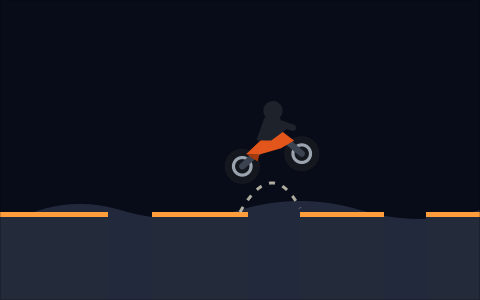
Desert Motorcycle Rush does the same thing to terrain. The dunes stay fair and the sandstorm takes your sight, so late in a run you are riding on rhythm rather than vision. Rated Medium, but the last third of a long run is as demanding as anything here.
Hard because of resource decisions
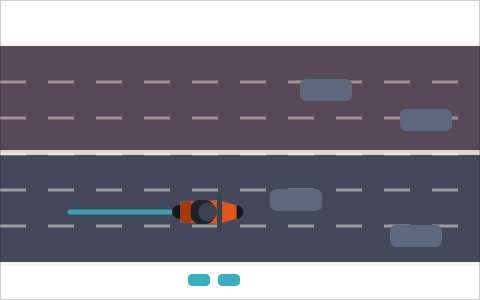
Traffic Bike Dash gives you three instant bursts and recharges them slowly, in two-way traffic where gaps close too fast to ride through. Every gap is a question: spend a charge, or hold position and wait?
Players who spend all three in the first ten seconds have very short runs, and that is the entire lesson. The other rule that matters: dash through a gap, not into it — the burst covers a fixed distance.
Super Bike Escape removes the usual safety valve. Braking to make a hazard easier hands ground to the pursuit behind you, so hazards that would be trivial at half speed have to be threaded at full speed.
Hard because it expects hundreds of attempts
Impossible Bike Track is a different proposition entirely: twenty-four fixed gaps, one button, and restarts fast enough that failure costs nothing. It is not testing your reflexes so much as your willingness to learn a sequence.
The design bet is that a fixed course plus an instant restart turns frustration into learning, and it mostly works. You will fail on gap four for a while, then clear it without thinking, then start failing on gap nine. The progress is unusually legible.
Bike Flip Master works the same way with a fixed eight-ramp course, except that only whole rotations score — so every jump carries a real decision.
Hard because it switches on you
Ultimate Motorcycle Arcade is four stages back to back, each about twenty seconds, each with a different control scheme. Every individual stage is easier than the dedicated game it is based on. Changing mental mode four times in eighty seconds is what makes it Hard.
It is also the most useful diagnostic on the site: whichever stage falls apart is the category you should go and practise.
How to actually improve at a hard game
Name the failure. “I died” is not information. Most players discover their failures are two or three repeated situations rather than bad luck.
Do a deliberately bad run. Play one round at a pace that scores terribly and watch the pattern structure instead of reacting to it.
Practise the component elsewhere. Twenty minutes of Motorcycle Wheelie makes the wheelie stage of Ultimate Motorcycle Arcade dramatically easier. The site is laid out so every mechanic has a game where it is the whole game.
Stop when you get worse. Two or three runs below your recent average is a signal to stop, not to push through. The next session usually starts higher.