What makes a trial game a trial game
Three things, usually. There is no clock, so you can study an obstacle for as long as you want. Movement is small and controlled rather than fast. And failure comes from imprecision — landing at the wrong angle, hopping from the wrong spot — rather than from being too slow.
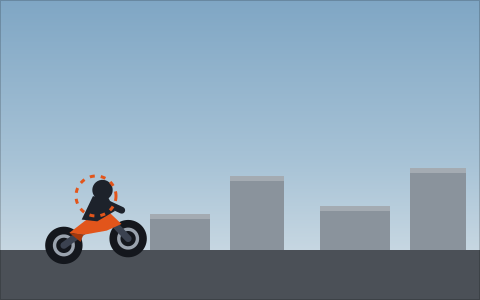
Motorcycle Trial is the closest thing here to the real discipline: stacked blocks, ledges and gaps, cleared with hops that you charge by holding the input. Tap for a small hop that clears a log; hold for a high one that needs a run-up and lands hard.
Reading a section before you ride it
Real trials riders walk a section before attempting it. The game equivalent is looking at the whole obstacle sequence rather than the first element of it, and asking one question: where will I be standing after this?
Landing on top of a block is frequently easier than clearing it, and it gives you a fresh platform to hop from. Players who insist on clearing every obstacle in one movement fail far more often than players who use the obstacle as a step.
Reversing is not failure either. Backing up two bike lengths to get a straight approach is standard practice, and the game gives you a reverse control precisely so you can.
Position matters more than the input
The most common beginner error is a perfectly judged hop from the wrong place. Charge length maps directly to hop height, so the input is learnable within a few minutes — three lengths, short, medium and full, will clear almost everything.
What takes longer is getting the bike to the right spot first. Set up, then charge. If you find yourself charging while still rolling into position, you are doing it in the wrong order.
Balance games are trials games too
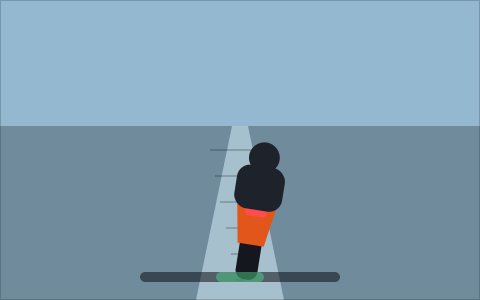
Motorcycle Balance takes the precision idea and removes the obstacles entirely. You are on a narrow beam, seen from behind, and the bike tips constantly. Left and right correct it; forward motion is a separate control that always costs you stability.
That separation is the clever part. Because advancing is optional, the game becomes a rhythm of correct, correct, creep forward, correct — rather than a continuous ride. Players who try to hold the forward key and steer simultaneously last about four seconds.
Build-then-ride: a different kind of precision
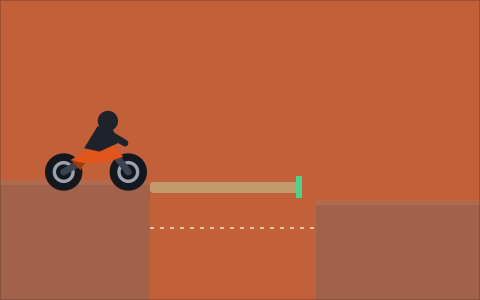
Bike Bridge Challenge splits every obstacle into a planning phase and an execution phase. Hold to extend a plank across a gap, release to drop it, then ride across what you built.
The catch that surprises everybody: a plank can be too long. Overshoot the far ledge and it sits at an angle and tips. Judge the plank against the gap rather than against your bike — the bike's length is a misleading reference and it is what makes people build short.
The precision game that is not a trial game
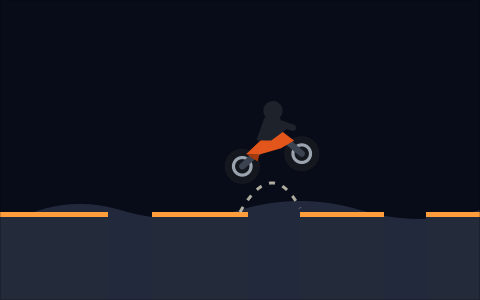
Impossible Bike Track sits in the trials category but works completely differently: one button, a fixed sequence of twenty-four gaps, and restarts fast enough that failure costs nothing. It belongs to the tradition of precision games that expect hundreds of attempts.
The technique that helps most is counter-intuitive: jump from the back third of a platform, not the edge. You get the same distance and a much larger margin for error.