Fixed courses: Impossible Bike Track and Bike Flip Master
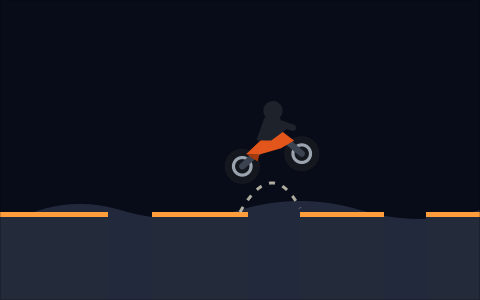
Impossible Bike Track is twenty-four gaps in the same order every attempt, with restarts fast enough that failure costs nothing. Four of those gaps are deliberately wide and need a held jump; the other twenty are rhythm. Memorising which four is most of the game.
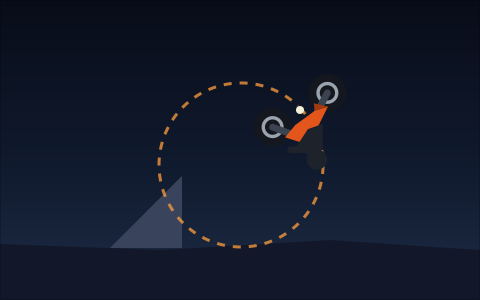
Bike Flip Master uses a fixed eight-ramp course for the same reason. Knowing that the third ramp is tall enough for a triple — if you arrive carrying speed from a clean second landing — is knowledge you can only build on a course that does not change.
How to play a fixed course: when you fail at the same place five times, stop and watch it once without acting. Seeing the shape properly is faster than five more attempts. And treat restarts as free, because they are — hesitation causes more failures on fixed courses than aggression does.
Generated courses: Motorcycle Trial and Bike Obstacle Run
Motorcycle Trial builds each section from a set of elements — blocks, stacks, ledges, gaps — and adds one more element as you progress. You cannot memorise it, so what you learn is how to read an obstacle and how much hop it needs.
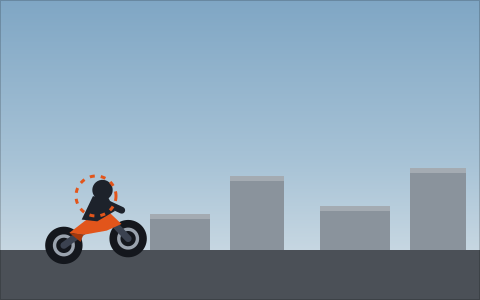
Bike Obstacle Run generates a stream of low and high barriers, with mixed pairs appearing later. The skill is identifying obstacle type at the far edge of the screen rather than as it arrives.
How to play a generated course: build a vocabulary. Once you can name what you are looking at — “that is a stack, it needs a medium hop from close in” — the variety stops mattering.
The hybrid: Bike Bridge Challenge
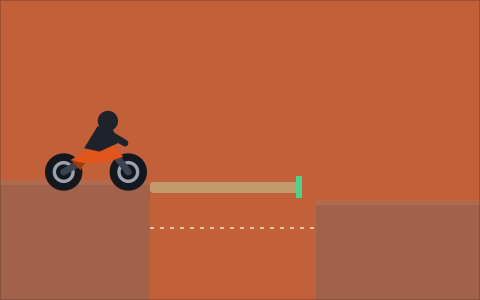
Bike Bridge Challenge generates the obstacles and lets you build the solution. Hold to extend a plank across a gap, release to drop it, then ride across what you built.
That gives you a measuring problem rather than a reading problem. The plank grows at a constant rate, so counting works — two counts for a narrow gap, four for a wide one, adjust from there. And a plank can be too long: overshoot the far ledge and it tips.
Reading an obstacle: the general method
- Identify the type. Height and shape tell you which action is needed. In Bike Obstacle Run, low means jump and high means duck, and choosing wrong is worse than being slightly late.
- Ask where you will be afterwards. Clearing an obstacle into a position you cannot escape from is the most common failure in Motorcycle Trial.
- Set position, then act. A perfect input from the wrong place fails; an average input from the right place usually clears.
- Use the obstacle. Landing on top of a block is often easier than clearing it, and gives you a fresh platform.
Why fixed courses feel harder but are not
Fixed courses have a wall: the specific gap you cannot yet clear. That feels harder than a generated course, where failure is spread across many different situations.
But a wall is progress you can see. You will fail on gap four for a while, then clear it without thinking, then start failing on gap nine. Generated courses hide your improvement inside an average, which is more comfortable and less informative.