How traffic games are actually built
Almost all traffic games generate vehicles in clusters rather than at an even rate. That is deliberate: an evenly spaced road is either trivially easy or impossible, whereas alternating between open stretches and dense walls creates a rhythm you can learn.
Vehicles also travel at varying speeds. A cluster that looks solid will spread out within a few seconds, which is why sitting behind one at matched speed is often better than attacking it.
In Highway Bike Racer you control your own speed, which means you control how hard the game is. Most players ride far faster than they need to, then blame the traffic.
Closing speed is the number that matters
What kills you is not another vehicle's speed, it is the difference between yours and theirs. Passing a car doing 200 while you do 220 gives you enormous time. Meeting an oncoming car doing 250 while you do 250 gives you almost none.
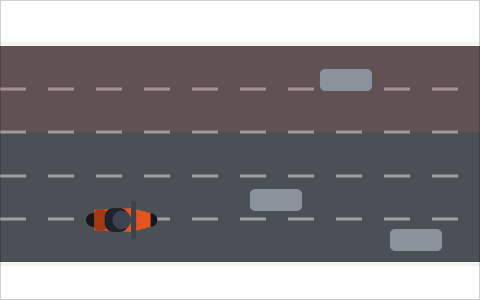
This is why Motorcycle Lane Rush marks its two oncoming lanes so clearly. The gaps up there look identical to the ones below and are roughly half as forgiving. The same is true of the upper half of the road in Traffic Bike Dash.
The practical rule: treat oncoming lanes as somewhere you visit briefly and deliberately, never as somewhere you sit.
Commit early — hesitation is the real killer
Watch replays of your own failures and you will notice how many involve a lane change that was started and then reconsidered. Being between two lanes is worse than being in either one, and that is exactly where hesitation puts you.
Pick the gap while it is still distant. If you get it wrong you at least arrive somewhere definite, and definite is survivable.
Braking is a tool, not an admission of failure
In every traffic game where you control speed, a short lift costs a small amount of score and buys a large amount of reaction time. Players resist it because slowing feels like losing.
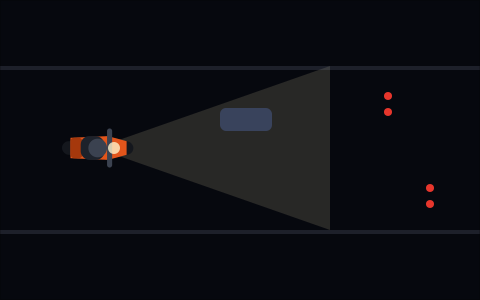
Night Highway Rider makes this explicit — your headlight reaches a fixed distance, so slowing down is the only way to increase how much warning you get. It is the game that teaches braking best, precisely because the consequences of not braking are so visible.
Near misses, multipliers and when to chase them
Highway Bike Racer pays a bonus for passing within roughly a bike's width of another vehicle, and those bonuses stack into a multiplier that decays when you are not overtaking. It exists to push you into riding closer than is comfortable.
The mistake is chasing near misses inside a dense cluster. A near miss is worth the same whether you take it with room around you or not, so take them on open stretches where a misjudgement is survivable.
Resource-based traffic games
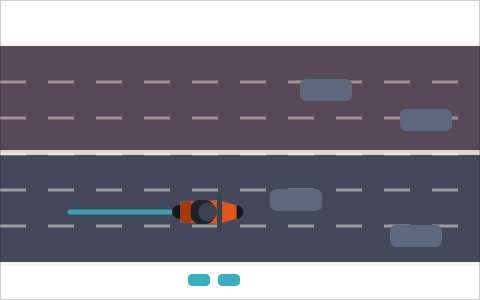
Traffic Bike Dash adds a different question: you have three instant forward bursts and they recharge slowly. Gaps open and close too fast to ride through, so a dash is how you take one — but spending all three early leaves you in two-way traffic with nothing.
The two rules that matter: never spend your last charge unless it saves the run, and dash through a gap rather than into it. A dash covers a fixed distance, so one that ends inside a gap is a dash into a vehicle.
If reaction tests are not your thing
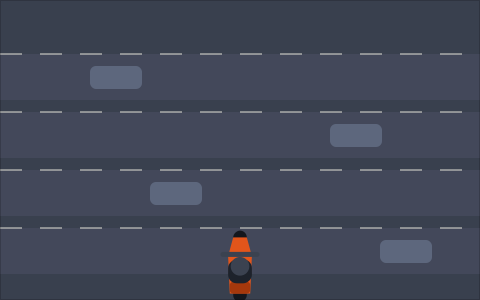
Traffic Bike Escape is the traffic game with no timer at all. It is top-down, you advance one lane per tap, and you can wait as long as you like. The only way to lose is to move when you should not have.
It is also the best place to practise reading lane density and speed, because you can study a lane for ten seconds before committing.